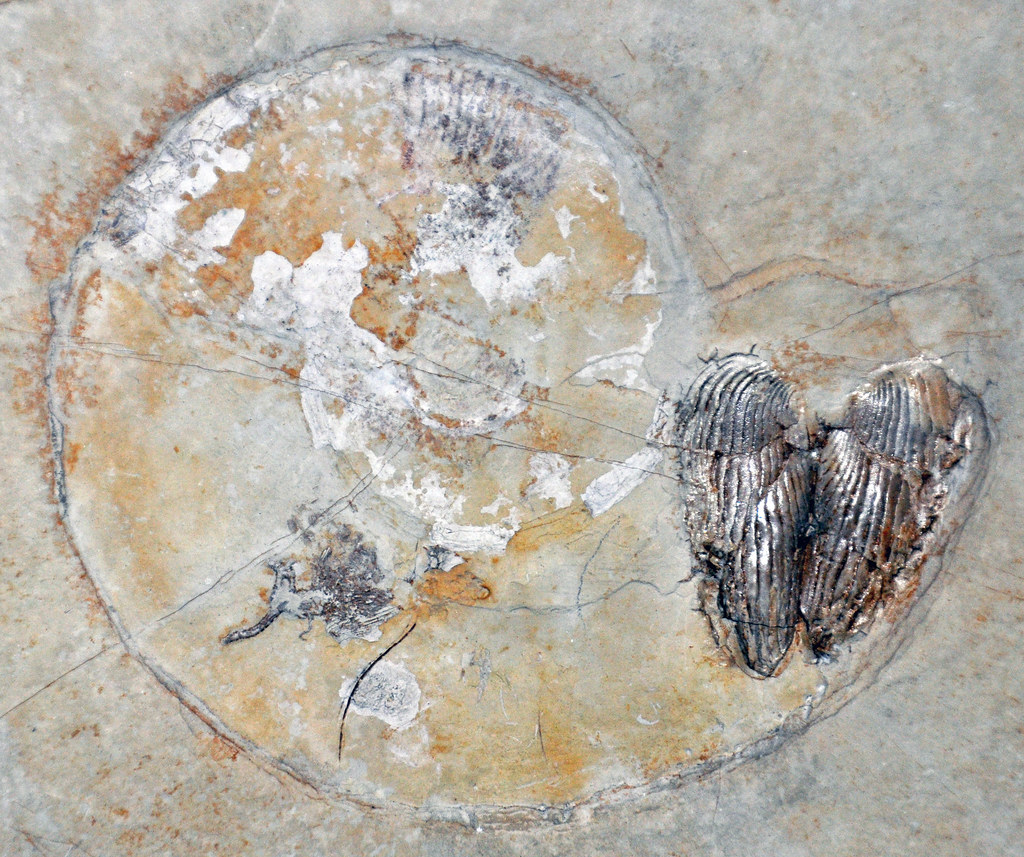
Radiocarbon dating is one of the best-known scientific tools for placing once-living things in time. It is also one of the most caricatured — popularly imagined as a single number printed on a label, when in practice it is a measurement with uncertainty, calibrated against centuries of independently dated samples.
This explainer walks through what radiocarbon actually measures, why dates have a range rather than a single year, and what the technique can and cannot tell us.
What radiocarbon is
Carbon comes in several forms (isotopes). Most carbon in the atmosphere is carbon-12, a small fraction is carbon-13, and a tiny fraction is carbon-14, which is radioactive. Carbon-14 is produced continuously in the upper atmosphere when cosmic rays interact with nitrogen. It mixes into the atmosphere as CO₂ and is taken up by plants in photosynthesis, then by the animals that eat those plants. While an organism is alive, its ratio of carbon-14 to carbon-12 stays roughly in equilibrium with the atmosphere.
When the organism dies, it stops taking in new carbon. From that moment, the carbon-14 in its tissues decays at a known rate, halving roughly every 5,730 years. Measuring the remaining carbon-14 ratio tells you how long ago the organism stopped taking up carbon.
How the measurement is done
Modern radiocarbon dating uses accelerator mass spectrometry (AMS), which counts individual carbon-14 atoms in a sample rather than waiting for them to decay. AMS requires only milligrams of material and can date samples up to roughly 50,000 years old; older than that, too little carbon-14 remains to measure reliably.
Suitable samples include charcoal, wood, bone collagen, shell, seeds, and textiles — anything organic that retained its original carbon. Stone, metal, and pottery cannot be dated directly, though organic residues associated with them often can.
Why dates have a range
A raw radiocarbon measurement gives a "conventional radiocarbon age" with a statistical uncertainty (e.g., 2,450 ± 30 years before present). But because the production of carbon-14 in the atmosphere has fluctuated over time — driven by changes in solar activity, geomagnetism, and the carbon cycle — that raw age has to be converted into a calendar age using a calibration curve.
The internationally agreed curve, IntCal, is built from tens of thousands of independently dated samples (tree rings, lake sediments, corals, speleothems) and is updated periodically. After calibration, results are reported as a calendar-age range with a probability, usually at 68% or 95% confidence — for example, "385–205 cal BC (95.4% probability)."
What it can and cannot date
Radiocarbon dating works on things that were once alive and finished taking up carbon between roughly 300 and 50,000 years ago. It cannot date rocks, fossils older than about 50,000 years, or materials that never contained organic carbon (most metals, most ceramics). For older or non-organic samples, other techniques apply — uranium-lead dating for very old rocks, optically stimulated luminescence for sediments, dendrochronology for tree-ring sequences.
The "reservoir effect" is a real complication for marine samples and animals that ate seafood: ocean carbon is older than atmospheric carbon, which makes raw radiocarbon ages too old by hundreds to thousands of years unless a regional correction is applied. Good dating labs account for this explicitly.
Why the technique is trusted
Radiocarbon dating has been cross-checked against independent dating methods — historical records, dendrochronology (tree-ring counts on millennia-long sequences), and varved lake sediments — for more than seven decades. Where samples can be dated by two independent methods, the agreement is generally excellent within stated uncertainties. The technique was awarded the 1960 Nobel Prize in Chemistry for its developer, Willard Libby.
That doesn't make every individual date correct. Contamination, poor sample selection, or unaccounted reservoir effects can produce misleading results. The discipline's response is the same as in any rigorous field: report uncertainties honestly, cross-check with other methods where possible, and treat individual outliers with skepticism.